🥦 Vegetable

How to Grow Tomatoes

The most popular backyard vegetable — and one of the most rewarding. From seeding indoors to pulling off that first ripe fruit, this guide covers everything zone by zone.

📅
50–85 days Days to maturity
☀️
Full Sun 6+ hours daily
🌡️
60–85°F Ideal growing temp
💧
1–2 in/week Water needed
📐
18–24 in Plant spacing
🌱
pH 6.0–6.8 Soil pH
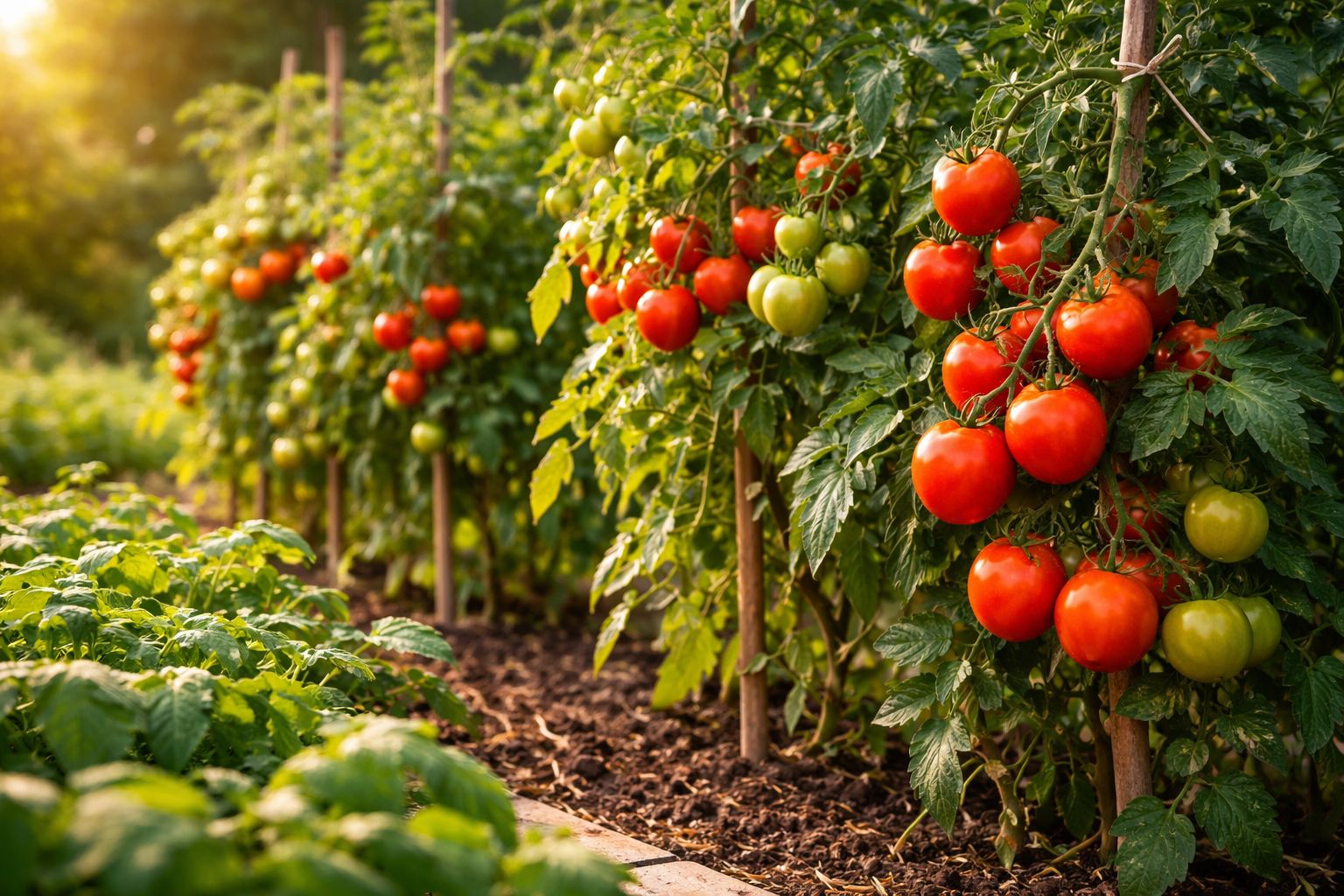
Ripe tomatoes growing on the vine in a sunny garden

Why Grow Tomatoes?

The numbers speak for themselves — one plant, all summer long.

Tomatoes are the backbone of the summer garden. A single healthy plant can produce 10–30 pounds of fruit over 8–12 weeks — far more than you'd spend buying them at the store. They grow well in raised beds, in-ground plots, and even large containers on a patio.

They're also incredibly versatile. Eat them fresh off the vine, slice them into salads, roast them for pasta sauce, or can them for year-round use. From tiny cherry tomatoes that pop in your mouth to massive beefsteaks that cover a whole sandwich, there's a variety for every taste and garden size.

The key to success is timing. Tomatoes are warm-season crops that hate frost — put them out too early and a cold snap can kill them; too late in cold climates and they won't ripen before fall. This guide gives you exact timing for every USDA zone.

Popular Tomato Varieties

Choose based on how you'll use them and how much space you have.

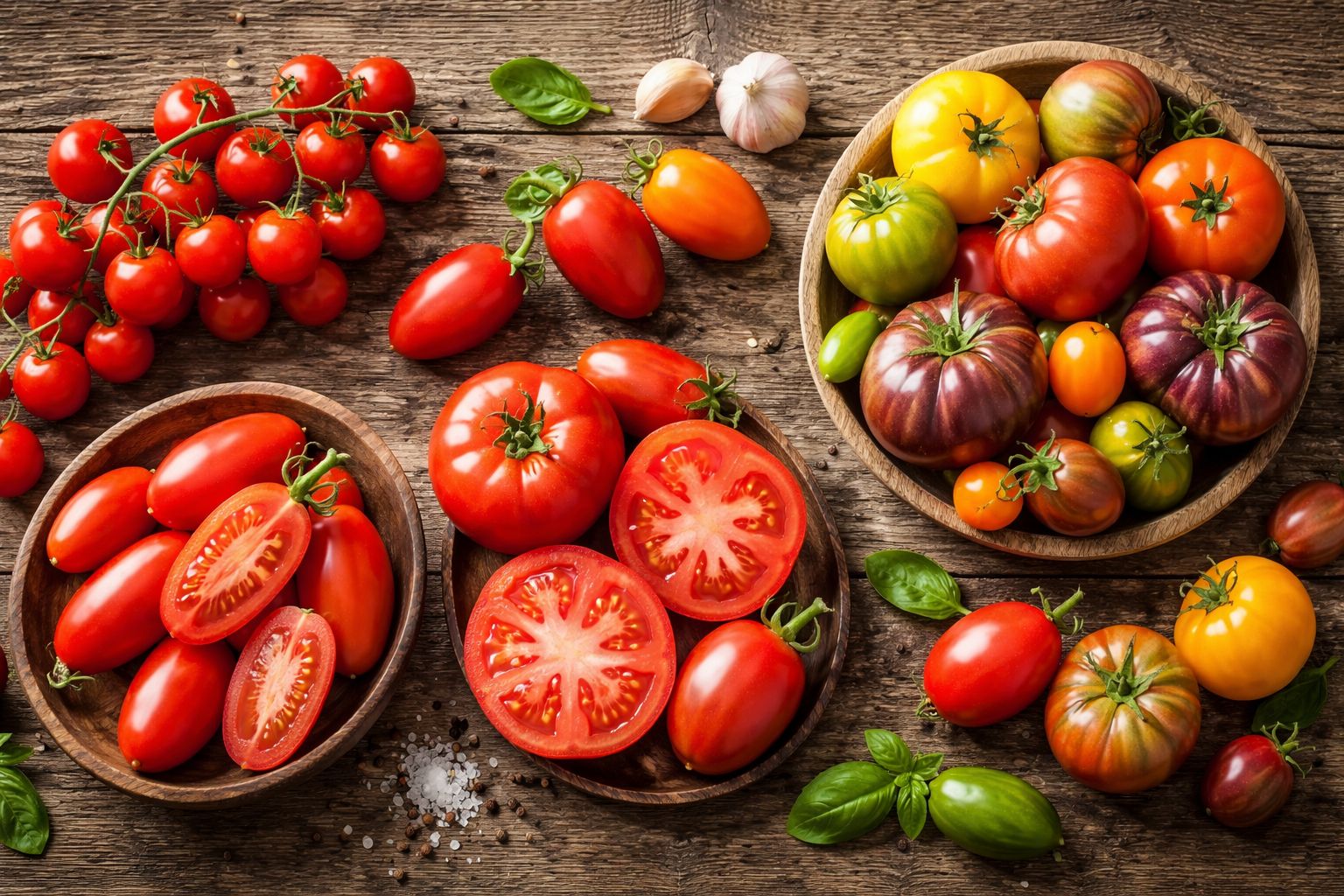
Four tomato types: cherry, roma, beefsteak, and heirloom tomatoes on a wooden table
🍒

Cherry Tomatoes

Small, sweet, and prolific. Best for snacking and salads. Easier to grow than large types — great for beginners.

50–65 days Prolific Container-friendly
🍅

Roma (Paste) Tomatoes

Meaty, low-moisture flesh ideal for sauces, canning, and roasting. Determinate — all ripen at once for easy processing.

70–80 days Sauce-perfect Determinate
🥩

Beefsteak Tomatoes

Large, juicy slicing tomatoes. Takes longer to mature but produces impressive fruit. Needs strong support.

70–85 days Large fruit Indeterminate
🌈

Heirloom Tomatoes

Open-pollinated varieties with intense flavor and striking colors. More disease-susceptible but incomparable taste.

70–85 days Unique flavor Save seeds
🧊 Cold climate tip:

In zones 3–5, choose early-maturing varieties (under 65 days) like Early Girl, Stupice, or Sub-Arctic Plenty. This gives you time to harvest before the first fall frost.

Growing Conditions at a Glance

Tomatoes are sun-hungry and warm-loving. Get these basics right and the rest follows.

☀️
Sunlight
Full sun
6+ hours/day
💧
Water
1–2 in/week
Deep, consistent
🌡️
Ideal Temp
60–85°F
16–29°C
🌱
Soil pH
6.0–6.8
Slightly acidic
🪨
Soil Type
Loamy
Well-draining
📐
Spacing
18–24 in
45–60 cm
🌿
Seed Depth
¼ inch
0.6 cm
🔥
Germination Temp
70–85°F
21–29°C

Planting Timeline

The full journey from seed to harvest — all dates are relative to your last spring frost.

🌱

Start Seeds Indoors

Sow seeds in warm soil (70–85°F). Seedlings emerge in 5–10 days.

6–8 weeks before frost
🪴

Harden Off

Gradually introduce seedlings to outdoor conditions over 7–10 days.

1–2 weeks before frost
🌿

Transplant

Plant out after last frost. Nights must stay above 50°F.

At / just after last frost
🌸

Flowering

Yellow flowers appear around week 4–5. Each flower becomes a fruit.

~4–5 weeks after transplant
🍅

Harvest

50–85 days from transplant. Pick when fully colored and slightly firm.

50–85 days after transplant

Zone-by-Zone Timing Guide

USDA Zone Typical Last Frost Start Seeds Indoors Transplant Window Notes
3a–4b May 15 – June 1 Late March – Early April Late May – Early June Use short-season varieties (<65 days). Row covers help.
5a–6b April 15 – May 15 Early–Mid March Late April – Mid May Most standard varieties work well.
7a–8b March 15 – April 15 Late January – Early February Late March – Mid April Wide variety selection. Ideal tomato climate.
9a–10b Jan 15 – Feb 28 November – December February – March Plant early before summer heat. Afternoon shade helps fruiting.
11+ No frost October – November December – January Grow in cooler months. Heat-tolerant varieties essential.

Step-by-Step Growing Guide

From first seed to last harvest — everything you need to know.
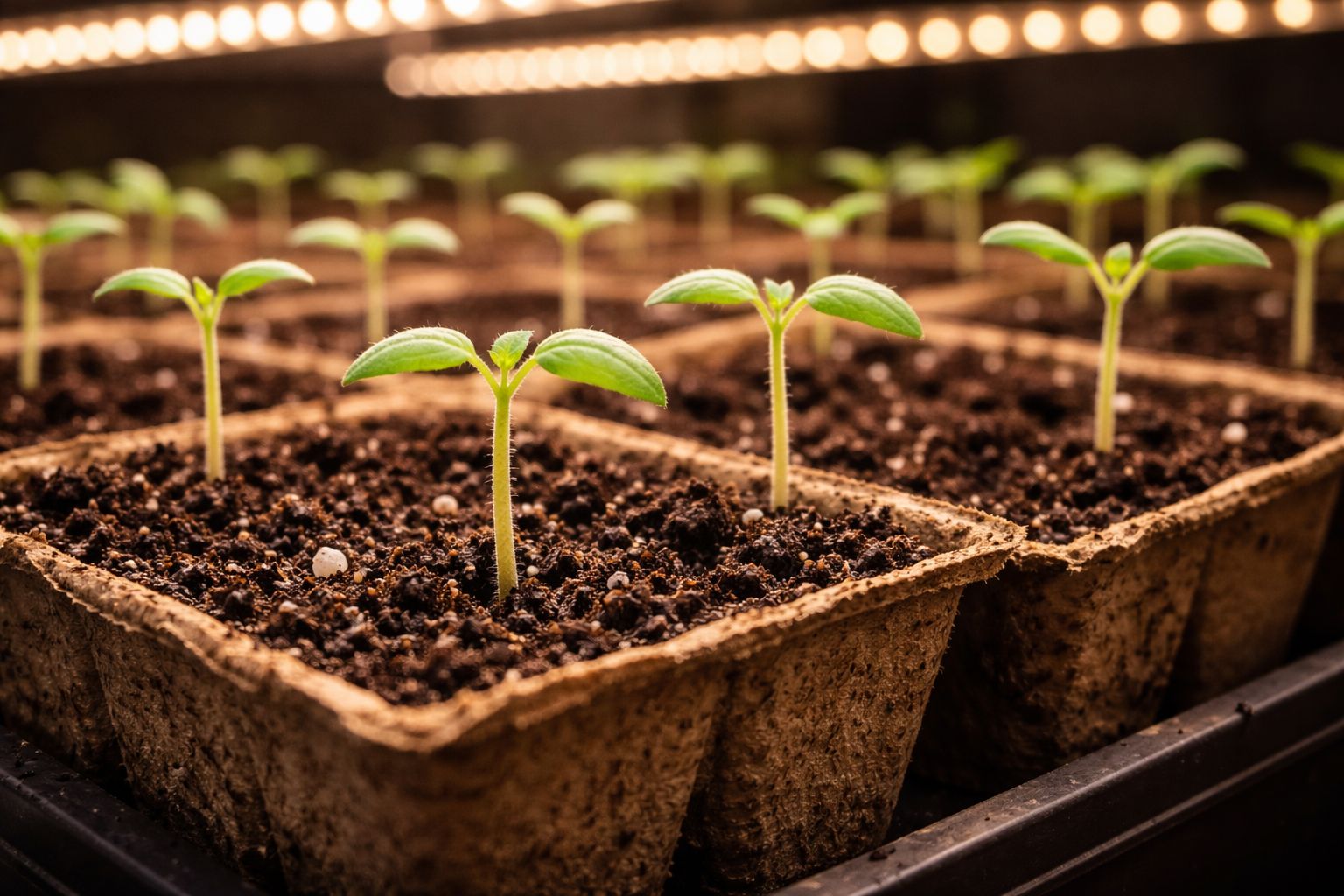
Tomato seedlings sprouting in seed trays under grow lights indoors

🌱 Step 1: Starting Seeds Indoors

Start seeds 6–8 weeks before your last expected frost. Fill small cells or pots with seed-starting mix (not regular potting soil — it drains better). Sow seeds ¼ inch deep, two per cell.

  • Keep soil temperature between 70–85°F (21–29°C) — a heat mat helps significantly
  • Seedlings emerge in 5–10 days as two small rounded leaves (cotyledons)
  • Once sprouted, move under bright light — a south-facing window or grow light 2–3 inches above seedlings
  • Thin to one seedling per cell once 2 inches tall
  • Water when the top half-inch of soil is dry
💡 Pro tip:

Tomato seedlings need at least 14–16 hours of light per day to stay compact. Without enough light, they grow tall and leggy — these "leggy" seedlings still work but are harder to manage at transplant time.

🪴 Step 2: Hardening Off

Before planting outdoors, seedlings need to be gradually introduced to outdoor conditions over 7–10 days. Skipping this step causes transplant shock.

  • Day 1–2: Place outside in a sheltered spot for 1–2 hours in the morning
  • Day 3–5: Increase to 4–6 hours including some direct sun
  • Day 6–10: Leave outside all day, bring in if frost is forecast
  • After day 10: Ready to plant permanently
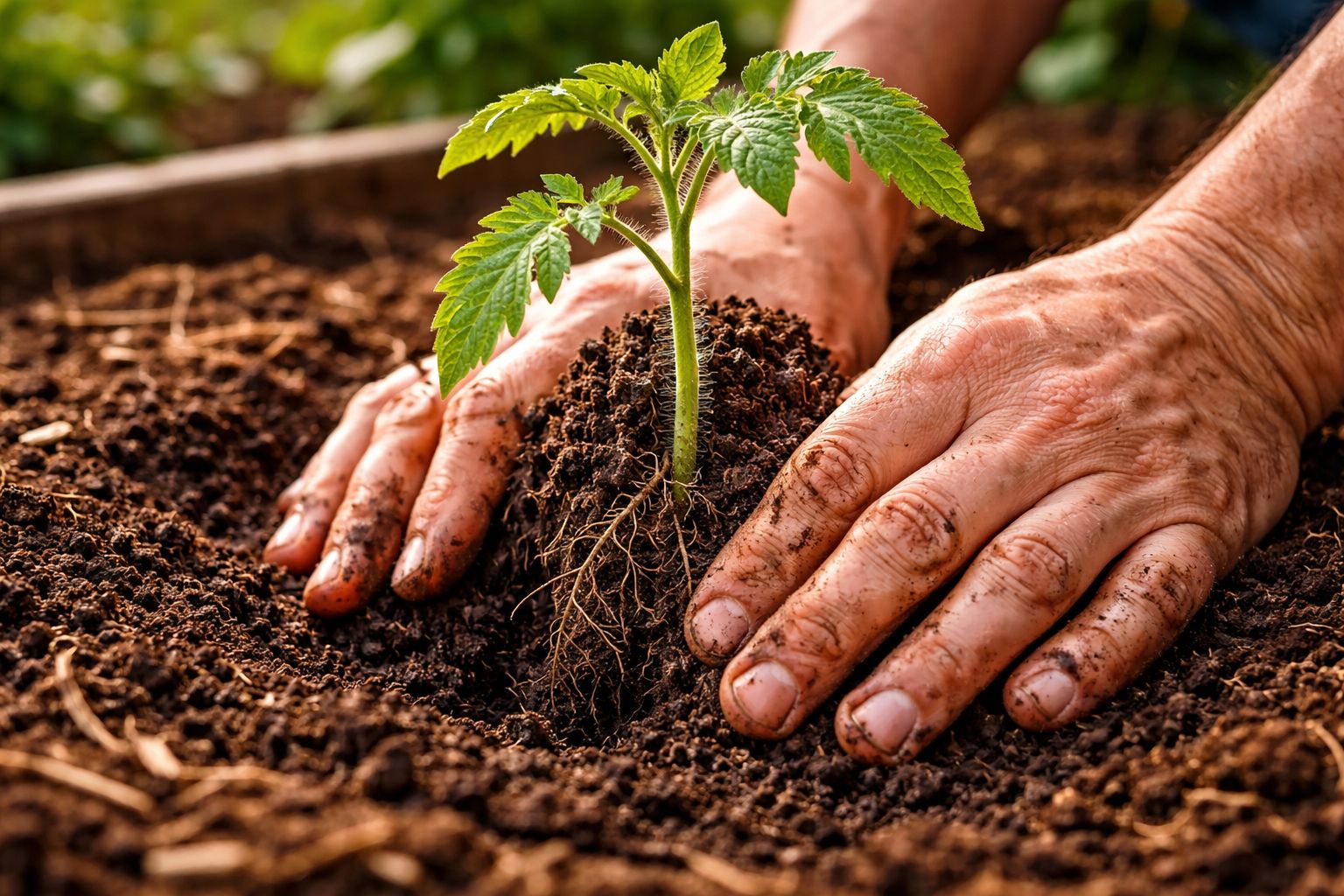
Gardener burying a tomato seedling deep in garden soil up to the first true leaves

🌿 Step 3: Transplanting

Transplant after your last frost date when nighttime temperatures consistently stay above 50°F (10°C). A single late frost can kill your plants, so check the forecast for 10+ days before planting.

  • Plant deep — bury the stem up to the lowest set of true leaves. The buried stem grows roots, creating a stronger plant
  • Space plants 18–24 inches apart in rows 3–4 feet apart
  • Install cages or stakes at planting time to avoid disturbing roots later
  • Water thoroughly at planting — 1 gallon per plant
  • Apply 2–3 inches of mulch around the base to retain moisture and prevent soil splash (which spreads disease)
🛒 Buying transplants:

Skip seed starting entirely by buying transplants from a nursery. Look for stocky, dark-green plants about 6–8 inches tall with no yellowing. Avoid plants already flowering — they've been stressed. This saves 6–8 weeks and gets you harvesting sooner.
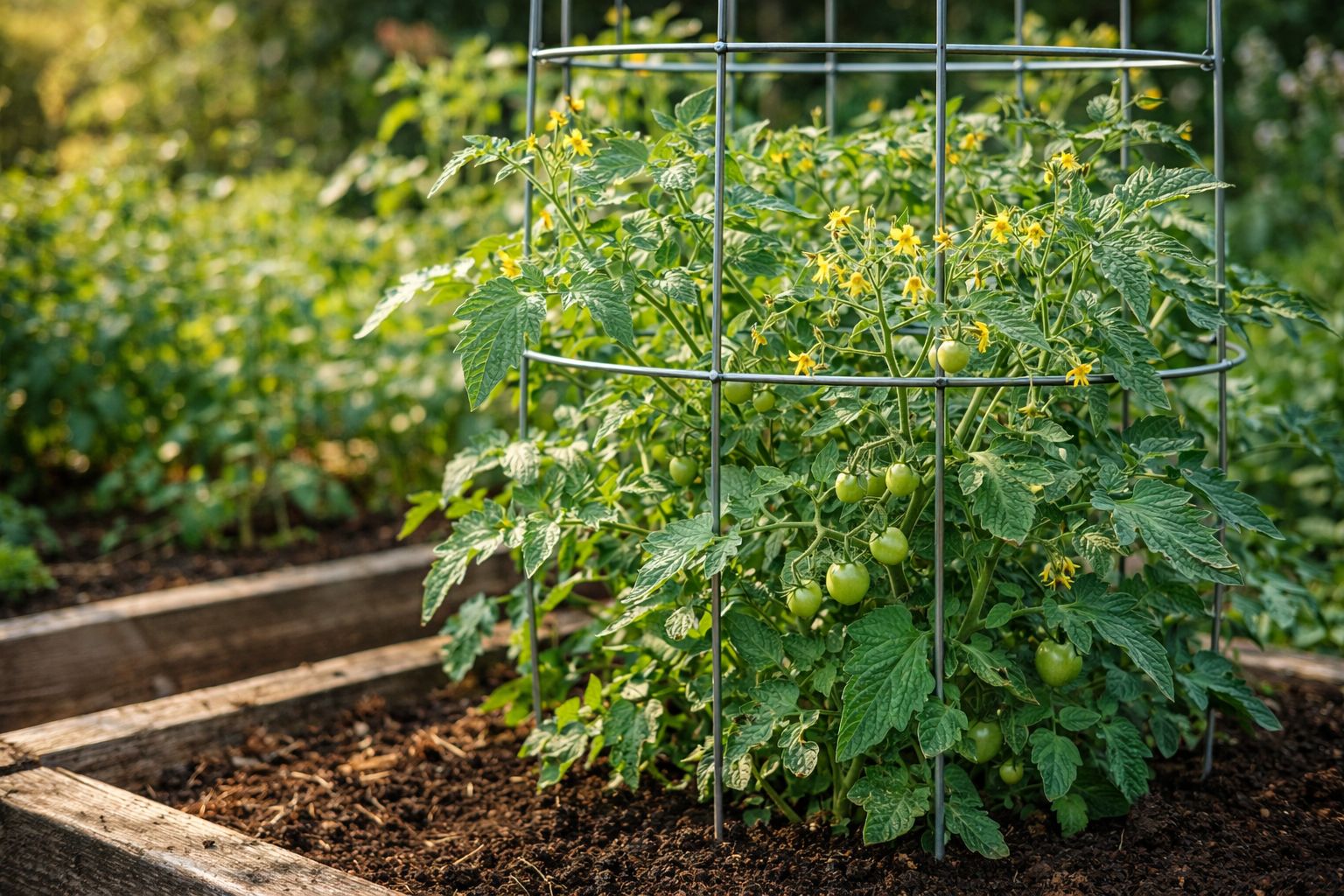
Healthy tomato plant growing on a cage support with yellow flowers and forming fruit

🌻 Step 4: Ongoing Care

For the first 3–4 weeks after transplanting, the plant focuses on root and leaf growth. The main stem thickens and side branches (laterals) develop.

Watering: Water deeply twice a week, soaking the soil 6–8 inches down. Inconsistent watering causes blossom-end rot and cracking. Drip irrigation or soaker hoses are ideal.

Feeding: Start fertilizing 2 weeks after transplanting. Use a balanced fertilizer (10-10-10) every 2 weeks until flowers appear, then switch to a low-nitrogen, high-phosphorus fertilizer to encourage fruit set instead of leaf growth.

Pruning suckers (for indeterminate varieties): Remove the small shoots growing between the main stem and branches — these are "suckers." Removing them focuses the plant's energy on fruit production. Do this weekly once plants are established.

  • Tie vines to supports as they grow — every 6–8 inches
  • Remove yellowing lower leaves to improve airflow
  • Top the plant (pinch the growing tip) 4 weeks before your first fall frost to direct energy into ripening existing fruit
Common Problems & Fixes

Most tomato problems are preventable. Here's what to watch for and how to respond.

Symptoms: Dark, sunken, leathery patch on the bottom of the fruit.

Cause: Irregular watering prevents calcium uptake — not usually a calcium shortage in the soil.

Fix: Water consistently and deeply. Mulch to retain even soil moisture. Avoid over-fertilizing with nitrogen. Affected fruit won't recover but new fruit will be fine once watering is consistent.

Symptoms: Dark brown spots with concentric rings (target-like) on lower leaves, starting from the bottom of the plant upward. Leaves yellow and drop.

Cause: Alternaria fungus — spreads through soil splash and wet foliage.

Fix: Remove and dispose of affected leaves. Mulch around the base to prevent soil splash. Water at the base (not overhead). Apply copper-based fungicide preventively. Rotate crops — don't plant tomatoes in the same spot for 3 years.

Symptoms: Flowers appear then fall off without setting fruit.

Cause: Temperature extremes (below 55°F or above 95°F at night), inconsistent watering, too much nitrogen, or insufficient pollination.

Fix: Plant at the right time for your zone. Shade plants during heat waves. Gently shake plants or use an electric toothbrush on flowers to aid pollination when temperatures are extreme. Cut back nitrogen once flowering starts.

Symptoms: Large sections of leaves suddenly stripped. Large green caterpillars (3–4 inches) on stems, easy to miss due to camouflage.

Cause: Manduca quinquemaculata moth larva.

Fix: Hand-pick caterpillars — check undersides of leaves in the morning. Drop into soapy water. Apply Bt (Bacillus thuringiensis) spray as a preventive. If you see white egg sacks on the hornworm, leave it — those are parasitic wasp eggs that will kill it naturally.

Symptoms: Radial or concentric cracks in the skin of maturing or ripe fruit.

Cause: Sudden heavy rain or watering after a dry period — the fruit expands faster than the skin can stretch.

Fix: Water consistently. Harvest ripe fruit promptly — the longer it stays on the vine, the more susceptible it is. Cracked tomatoes are still edible; use them quickly before rot sets in.

Bottom leaves yellowing: Normal as plants mature — lower leaves get shaded. Remove them to improve airflow. Could also be early blight (see above).

New leaves yellowing: Likely nitrogen deficiency — fertilize with a balanced fertilizer. Could also be overwatering (waterlogged roots can't uptake nutrients).

Yellow with green veins: Magnesium deficiency — spray leaves with diluted Epsom salt solution (1 tablespoon per gallon).

Harvest & Storage

Knowing when and how to pick is just as important as the growing.

🔍

When to Harvest

  • Fully colored (red, yellow, orange, or purple depending on variety)
  • Slightly soft when gently squeezed — not hard, not mushy
  • Comes off the vine easily with a light twist
  • Pick in the morning when temperatures are cooler

You can pick when just starting to color and let them ripen on the counter — this protects from pests and cracking.

📦

Storage Tips

  • Counter (best): Ripe tomatoes keep 5–7 days at room temperature, stem side down
  • Refrigerator: Only once cut or overripe — cold ruins the texture and kills flavor
  • Freeze: Blanch and peel, then freeze whole or chopped for cooking
  • Can: Process in a water bath for shelf-stable sauce or whole tomatoes
📊

Expected Yield

Yield varies by variety and care:

  • Cherry: 3–8 lbs per plant, very prolific
  • Roma: 8–15 lbs per plant
  • Beefsteak: 10–20 lbs per plant
  • Indeterminate types keep producing until frost
  • Determinate types ripen all at once over 2–3 weeks
🍂

End of Season

  • 4 weeks before first fall frost: pinch off the growing tip to push energy into existing fruit
  • Green tomatoes can be ripened indoors in a single layer at room temperature
  • Wrap in newspaper individually for slower, longer ripening
  • Save seeds from heirloom varieties: ferment, rinse, and dry before storing

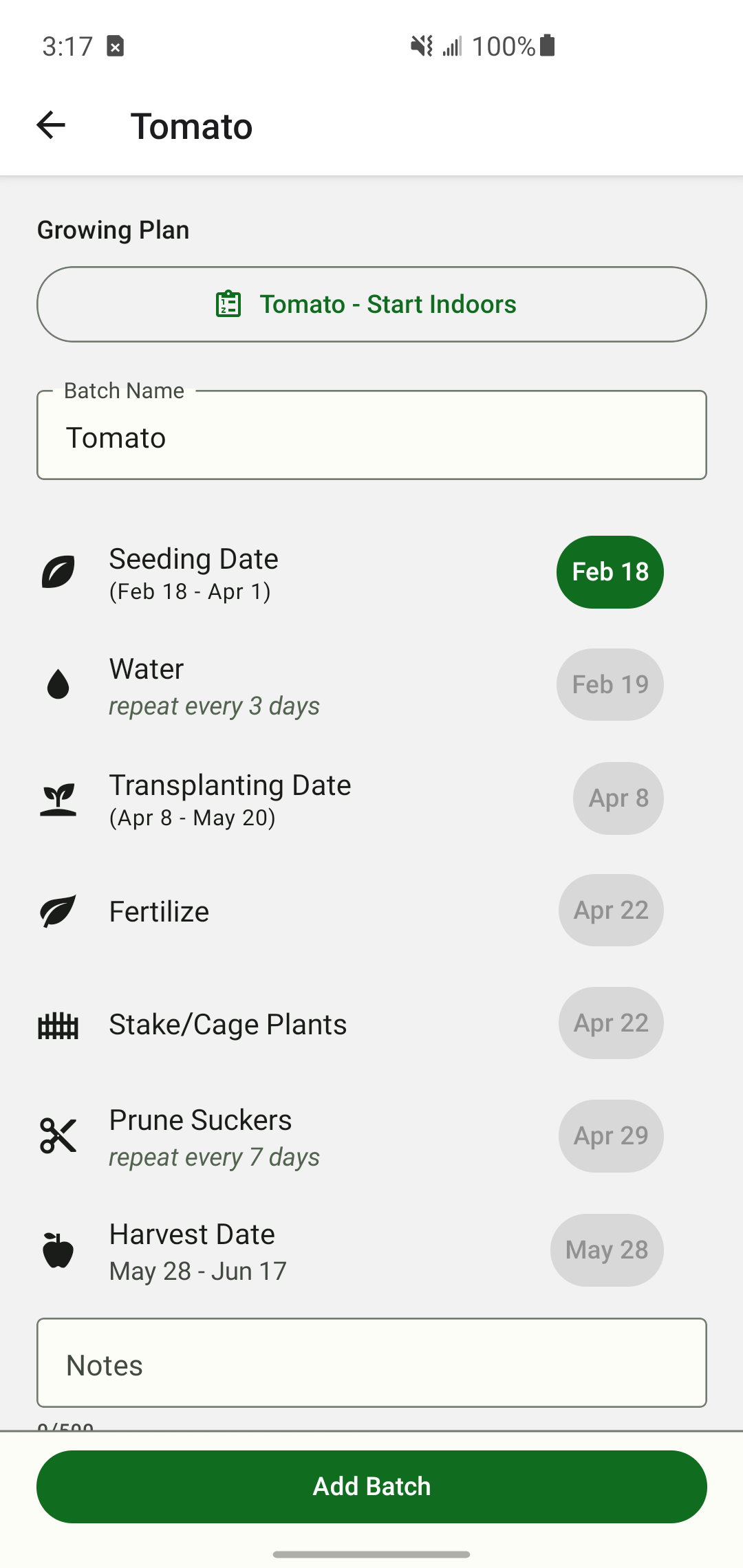
🌱 Track Your Tomatoes in GrowPlanner

GrowPlanner automatically calculates your personalized planting dates based on your USDA zone and frost dates — so you never have to look up timing again. Set up once, follow the task reminders all season.

  1. 1 Open GrowPlanner → enter your zone and frost dates during onboarding
  2. 2 Search for "Tomato" in the plant catalog and tap it
  3. 3 Choose "Buy Transplant" or "Start Indoors" — the app shows your exact window
  4. 4 Tap "Add Batch" — all tasks are created automatically with correct dates
  5. 5 Get reminders for watering, fertilizing, pruning, and harvest
GrowPlanner app showing tomato batch creation with zone-aware planting dates